Professionals
How to use aquafaba in your pastry kitchen or bakery
In a pastry section, one ingredient covers the meringue, the macaron shells, the chocolate mousse and the egg-free sponges: 30g of aquafaba per egg white, 45g per whole egg. The guides give you each recipe. Below, the section as a whole: how many batches a pack gives, which format fits your oven schedule, how to plan the week, and how to move a recipe of your own across. Updated: .
Professional volumes, formats and the technical sheet are answered per project, so tell us what you are making and how much of it.
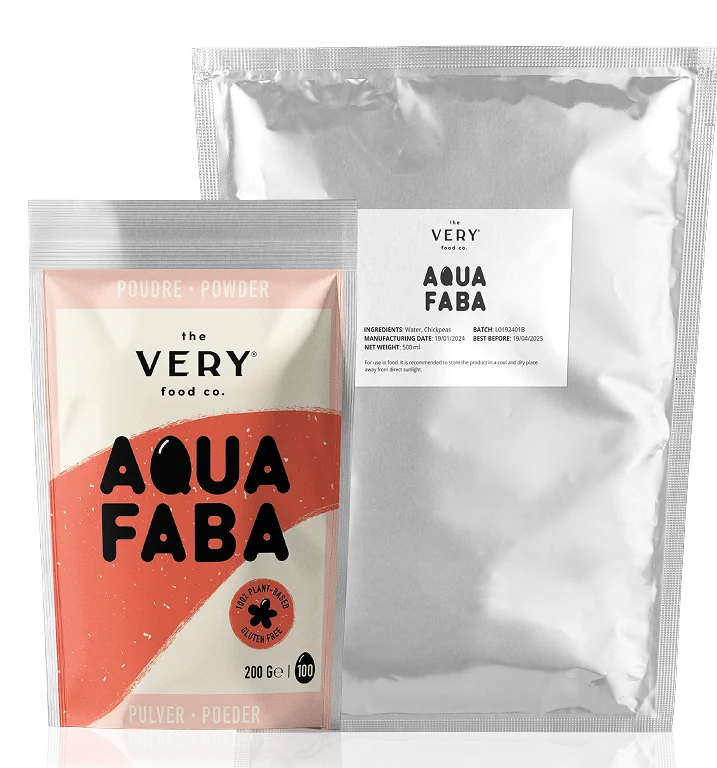
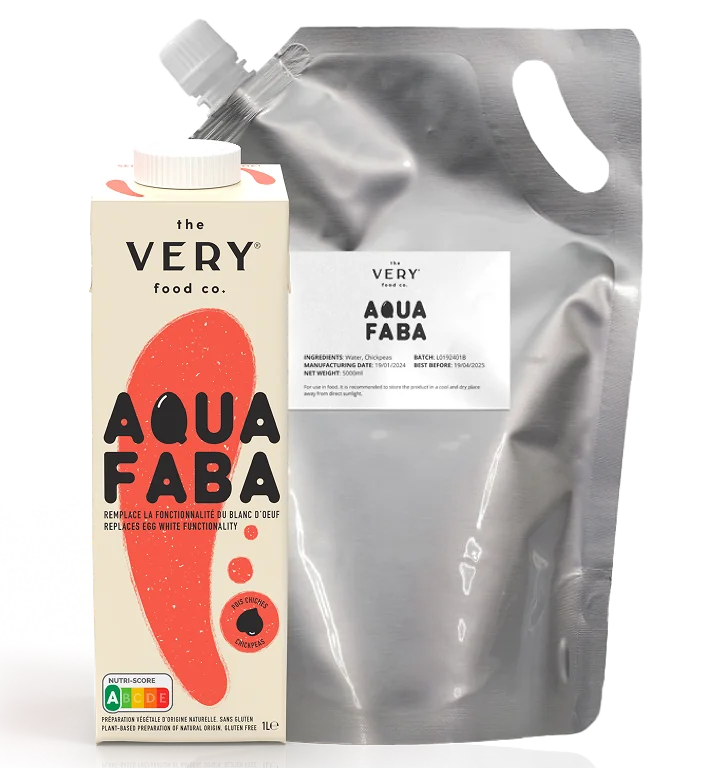
What you can make, and how much a pack gives
Every batch is counted in egg whites, so a pack is easiest to picture by the batches it gives. The figures come from the VERY AQUAFABA recipes; each application has its own guide and quantity calculator.
| Application | One batch | From a 1L Tetrapak | From a 200g pouch |
|---|---|---|---|
| Meringue | 150g, or 5 egg whites, for about 30 meringues | 6 batches | 20 batches |
| Macarons | 120g, or 4 egg whites, for about 40 macarons | 8 batches | 25 batches |
| Chocolate mousse | 120g, or 4 egg whites, for about 6 portions | 8 batches | 25 batches |
| Sponges, cakes, doughs | 45g per whole egg, 30g per egg white | 22 whole eggs or 33 egg whites | 100 egg whites |
In powder, a batch is made up at 2g plus 30 ml of water per egg white: 10g and 150 ml for a meringue batch, 8g and 120 ml for macarons or mousse. The reconstitution page has the table from 1 to 20 egg whites.
Will you finish an opened pack in time?
Sealed, both formats keep at least 12 months at room temperature, so the choice only begins once a pack is open. From then on, liquid lives in the fridge and is used within 3 to 4 days, while powder simply waits, dry and closed. A 1L Tetrapak is 6 batches of meringue or 8 of macarons. If your oven schedule gets through that in 3 to 4 days, liquid is the easy choice. If it does not, powder is.
| Your kitchen | Pick | Why |
|---|---|---|
| Pastry section piping meringue or macarons most days | Liquid, 1L Tetrapak | The pack is empty well inside 3 to 4 days |
| Shop baking to order, or a seasonal meringue dessert | Powder, 200g pouch | It covers the long gaps between runs |
| Chiller full of creams, ganache and maturing macarons | Powder | The pouch lives on a dry rack, outside the cold store |
| Daily egg-free line plus irregular orders | Both | Liquid for the line, powder for the orders; the recipe is the same on either |
| Plant-based patisserie line piping continuously | Liquid, 10L bag-in-box or 1T IBC | Continuous use, with nothing to make up |
If you prefer liquid but bake irregularly, you can freeze it in portions of 30 to 50g at -18 °C for up to 3 months. Thaw overnight in the fridge and stir until even before whipping. It is never refrozen.
Which desserts hold, and for how long?
Aquafaba fits a make-ahead section better than raw egg white does, because none of the finished products depends on the fridge in the same way. Here is what each one asks for once it is made:
- Meringues cool fully on the tray and keep airtight at room temperature, in a dry place, with a desiccant pouch if you have one. They pull moisture from the air, so the dry store, not the chiller, is their home.
- Macarons are filled, then refrigerated for 24 hours before service, so the shells and the filling come together. Bake the shells one day, fill and mature the next.
- Chocolate mousse sets in the fridge in 2 hours and keeps 3 days in sealed packaging, so it is a batch product made ahead, not a dessert made to order.
Only two things in the section need the cold: the mousse and the maturing macarons, plus the opened liquid pack. That is the pack to plan around. Open it at the start of a run of oven days, write the opening date on it, and it is gone before the 3 to 4 days are up. Label what you freeze with the date and the weight, as the storage guide asks, so that a portion taken out on a busy morning is the right one.
How to move your own recipes to aquafaba
Start with the recipe that matters most on your counter, not the one that looks easiest, and change only the egg. What you replace decides what else moves:
- Egg whites only, as in meringue, macarons and mousse: a direct swap. 30g of aquafaba per white, and the almond flour, the sugar and the chocolate stay exactly as they are.
- Whole eggs, as in sponges and cakes: 45g per egg. Aquafaba carries more water than an egg, about 90 to 92 percent against 75 percent, so bring the other liquids down by 5 to 10 percent and bake dense cakes through.
- Yolks: 15g of aquafaba plus 10g of oil, because aquafaba brings no fat.
Weigh everything, the aquafaba included, and keep the rest of the method as it was: same bowl, same speeds, same oven. If the section bakes in volume, check each lot with a refractometer against the supplier specification of 2 to 4 °Brix, so the foam behaves the same on every run. The substitution calculator converts the eggs, whites and yolks of your recipe in one go, and the baking guide covers what to do when a sponge comes out flat or wet.