Professional application guide
Aquafaba for baking: liquid or powder?
Aquafaba for baking can stand in for whole eggs or just the whites, from génoise to brioche. Count 45g for each egg you replace. You'll see how it goes into each kind of bake, what to adjust in your recipe, and how to pick the format that suits your production. Updated: .
One whole egg = 45g of liquid aquafaba.
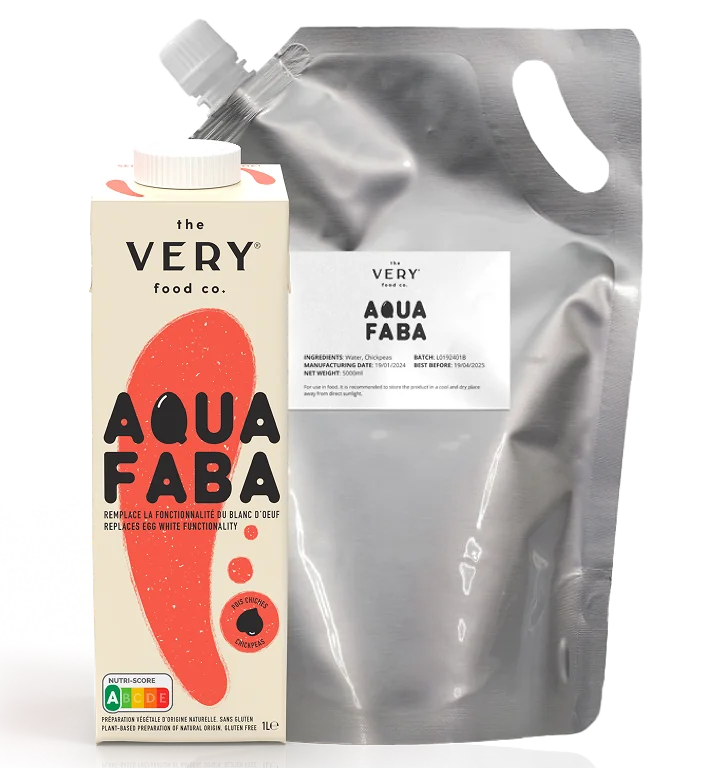
Liquid
- 30gper egg white
- 33 egg whitesfrom a 1L Tetrapak
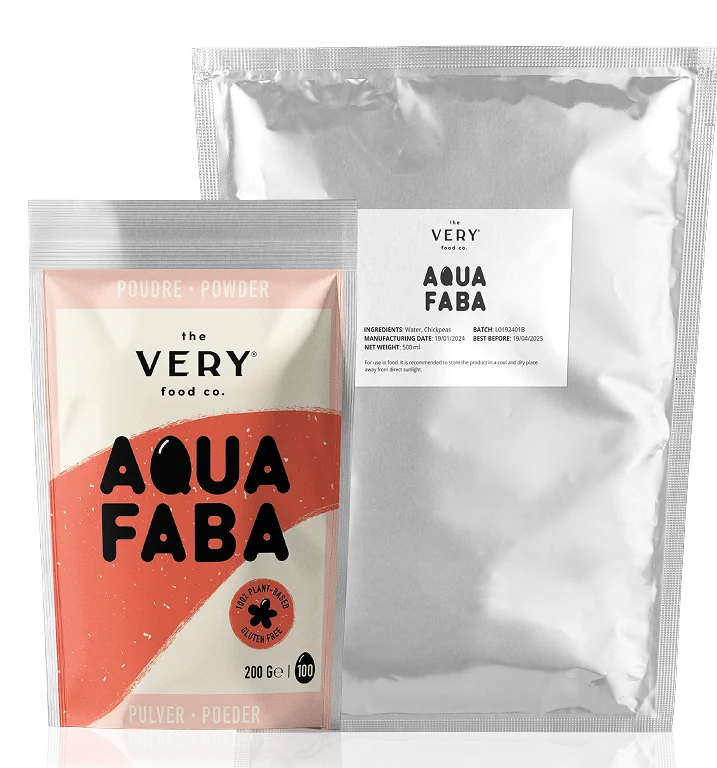
Powder
- 2gper egg white, mixed with water
- 100 egg whitesfrom a 200g pouch
How to use aquafaba in your bakes
Aquafaba does three jobs in baking: it traps air, it binds, and it holds moisture. So it works in two ways. Whip it when it replaces egg whites. Pour it in as it is when it replaces the binding and moisture of whole eggs.
| What you bake | How the aquafaba goes in | What it brings |
|---|---|---|
| Sponges and génoise | Whipped at 4 to 6 °C, then folded in gently and promptly | The air |
| Cakes, cookies and muffins | Mixed with the sugar before it meets the fat | A more stable emulsion |
| High-sugar batters | Whipped with part of the sugar first, then combined with the fats | Volume that lasts through the bake |
| Cookies and brownies | Added directly, unwhipped | Binding and moisture |
| Brioche and sweet rolls | Unwhipped, with the liquids of the dough | Softness and keeping quality |
Replacing whole eggs? Aquafaba carries more water than egg. Reduce the milk or water slightly, or raise the dry ingredients, and bake fully. Replacing only the whites, as in meringues or macarons, normally needs no adjustment.
Liquid or powder? Start with how often you bake egg-free
Made up with water, the powder brings the same water into the batter as the liquid, so the recipe work is identical. The choice is about pace and storage. A 1L Tetrapak replaces 22 whole eggs or 33 egg whites and, once opened, is used within 3 to 4 days in the fridge. A 200g pouch replaces 100 egg whites and does not spoil after opening.
| Your kitchen | Pick | Why |
|---|---|---|
| Bakery with an egg-free line every day | Liquid, 1L Tetrapak | An opened pack is empty well inside 3 to 4 days |
| Kitchen with occasional vegan orders | Powder, 200g pouch | Make up what the order needs, the rest waits |
| Sponges and génoise whipped for volume | Liquid | The opened pack already sits at whipping temperature |
| Chilled shelves committed to creams and fillings | Powder | It lives on a dry rack |
| Daily line plus irregular orders | Both | The conversion is fixed, so a recipe runs on either |
| Industrial bakery line or multi-outlet foodservice | Liquid, 10L bag-in-box or 1T IBC | Continuous dosing, no reconstitution step |
Uneven rotation but you prefer liquid? Freezing in portions works, at the cost of freezer space, an overnight thaw and a viscosity check. That is the workflow the powder removes.
Working with each format
Liquid
- Weigh 45g per whole egg or 30g per egg white, straight from the pack.
- Discard it if it smells off, shows bubbles or has separated.
Powder
- 2g powder + 30 ml water = 32g of aquafaba, equivalent to the same mass of liquid aquafaba. 2g of powder replaces 1 egg white.
- For whipped bakes, chill it to 4 to 6 °C first. For doughs and batters it goes in as it is.
When the bake goes wrong
| What you see | Why | Fix |
|---|---|---|
| Flat sponge | The foam stood waiting, or was folded too hard | Fold in promptly and gently |
| Loose, wet batter | Whole eggs swapped one for one, water not reduced | Reduce the milk or water slightly, or add dry ingredients |
| Wet centre | The extra water lengthens the bake | Bake fully before you pull it |
| Weak foam | Aquafaba too warm | Whip it at 4 to 6 °C |
| Weak foam or binding from frozen stock | Thawed aquafaba came back thinner | Reduce briefly over low heat. Never refreeze |
| Shelf life of the product has shifted | Changing moisture changes water activity | Re-check shelf life and microbial stability after reformulating |
Where to buy VERY AQUAFABA
Professional enquiries: Discuss your production needs
General enquiries: Get in touch