Professionals
How to use aquafaba in a central kitchen: the complete guide
A central kitchen makes the mayonnaise, the desserts and the egg-free bakes that its outlets serve. Aquafaba covers all of them from one ingredient: 30g per egg white, 45g per whole egg. Below, a day in that kitchen: what a shift can produce, what travels well and for how long, and how to keep the outlets running on the same recipe. Updated: .
Professional volumes, formats and the technical sheet are answered per project, so tell us what you are making and how much of it.
Why central kitchens are switching to aquafaba
Feeding several sites from one kitchen means every ingredient has to hold up twice: once in production and once on the road. Aquafaba earns its place for three reasons:
- One ingredient, four jobs. It emulsifies the mayonnaise, whips into the mousse and the meringue, and binds the sponges and doughs. One line in the stock list replaces the egg in all of them.
- Nothing raw in the cold sauces. Mayonnaise is served uncooked. Aquafaba replaces the egg with no raw-egg risk in the dish that leaves the kitchen.
- Stock that waits. Sealed, both formats keep at least 12 months at room temperature, in the dry store, not the walk-in. The clock only starts once a pack is open.
What one shift can produce
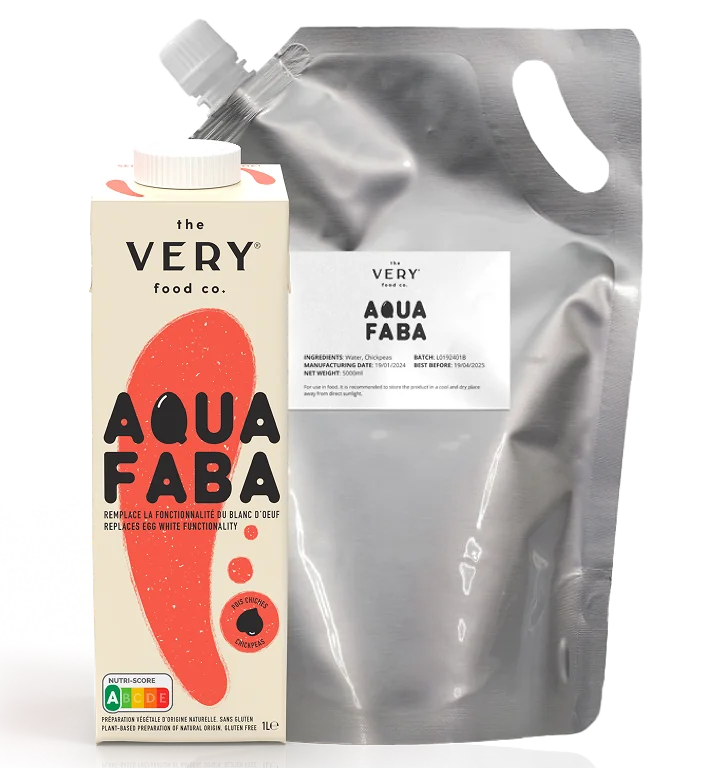
The batch figures are those of the VERY AQUAFABA recipes. The 10L bag-in-box is the pack most central kitchens draw from; the 1L Tetrapak serves a single site.
| Application | One batch | From a 10L bag-in-box | From a 1L Tetrapak |
|---|---|---|---|
| Mayonnaise | 60g of aquafaba for about 500g of mayo | 166 batches | 16 batches |
| Chocolate mousse | 120g for about 6 portions | 83 batches | 8 batches |
| Meringue | 150g for about 30 meringues | 66 batches | 6 batches |
| Sponges, cakes, doughs | 45g per whole egg | 222 whole eggs | 22 whole eggs |
Mayonnaise uses very little aquafaba per batch, which is why even a 1L pack goes a long way on a sauce station. The question is never whether a pack is big enough; it is whether an opened one is used up within 3 to 4 days. Each guide has a quantity calculator that scales the batch to your run.
What travels well, and for how long
This is where aquafaba makes life easier for a kitchen that dispatches. Once made, each product asks for something different:
- Mayonnaise keeps up to 7 days refrigerated, made under hygienic conditions, in a clean container and chilled straight after blending. It ships finished.
- Chocolate mousse sets in the fridge and keeps 3 days in sealed packaging. Portion it centrally and ship it set.
- Meringues keep airtight at room temperature in a dry place. No cold chain on the van.
- Bakes and enriched doughs stay soft longer, because aquafaba slows drying in the crumb. That is a day or two of extra shelf life on the way to the outlet.
Label every container with the production date and the weight before it leaves, as the storage guide asks. It is the one habit that keeps a dispatch traceable from the mixer to the outlet's fridge.
Keeping the outlets running
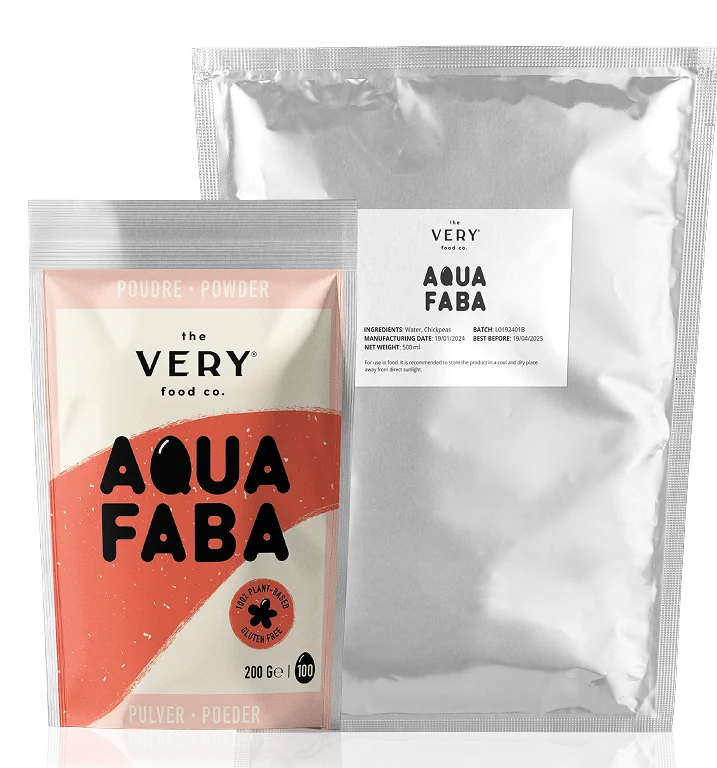
Most groups split the two formats by where the work happens. The central kitchen draws liquid from the bag-in-box, because its use is continuous and an opened pack turns over in time. The outlets that whip or blend on site keep a 200g pouch of powder on the shelf, because a quiet week does not spoil it.
| Your operation | Pick | Why |
|---|---|---|
| Central kitchen drawing aquafaba by the kilo each shift | Liquid, 10L bag-in-box or 1T IBC | Continuous use, straight into the mixer, nothing to make up |
| Deli or sandwich counter making fresh mayo every service | Liquid, 1L Tetrapak | Poured at blending temperature, and the pack turns over in time |
| Outlet with mayo or mousse on one dish | Powder, 200g pouch | An opened litre would outlast its 3 to 4 days; the pouch waits |
| Cold store already full of finished sauce and portions | Powder | The pouch never takes a chilled slot |
| Outlet that wants fewer dated items to log | Powder | No opened, perishable pack to label and inspect |
The recipe does not change between the two: 30g of liquid is 2g of powder made up with 30 ml of water, so a sauce developed centrally runs the same at the outlet. For the largest kitchens and continuous lines, the food manufacturing page covers the 1T IBC.