Professionals
How to use aquafaba on a production line: the complete guide
On a production line, aquafaba runs as a liquid, drawn from the 1T IBC or the 10L bag-in-box and dosed by weight. It arrives filtered, refined and within a supplier specification of 2 to 4 °Brix, so a foam or an emulsion behaves the same on every run. Below, the work from the first trial to the signed-off specification: replacing the egg in your formula, what changes at scale, which pack fits the line, and how to get a quote. Updated: .
Professional volumes, formats and the technical sheet are answered per project, so tell us what you are making and how much of it.
Why manufacturers are switching to aquafaba
Four things a plant-based egg replacement brings to a line, all of them on the pack or on the price list rather than in a claim:
- A plant-based, egg-free ingredient. No eggs, dairy, gluten or soy, which takes a major allergen out of the formula and opens the product to plant-based ranges.
- A price that does not follow the egg market. Egg prices move with feed costs, disease and supply shocks. Aquafaba does not.
- A standardised input. Every batch arrives within a supplier specification of 2 to 4 °Brix, which is what keeps a foam or an emulsion reproducible from one run to the next.
- Stock that waits. Sealed, the packs keep at least 12 months at room temperature. On a continuous line an opened pack never reaches its 3 to 4 days.
Replacing the egg in your formula
The conversion is by weight, and it is the same rule the whole site uses. Count the eggs, the whites and the yolks in the formula, then swap them one for one:
- 45g of aquafaba per whole egg.
- 30g per egg white.
- 15g of aquafaba plus 10g of oil per yolk, because aquafaba brings no fat.
Replacing egg whites is a direct swap. Replacing whole eggs brings extra water: aquafaba is about 90 to 92 percent water against 75 percent for an egg, so the other liquids come down by 5 to 10 percent and dense bakes are baked through. Take one product at a time, change only the egg, and let the trial batches confirm time, colour and texture before the change goes into the standard procedure. The substitution calculator converts a whole formula, and the egg ratio page carries the rule with worked examples.
What to watch when you scale up
A formula that works at the bench meets four new variables on the line. Each one comes from a VERY AQUAFABA recipe written for production:
- Check the consistency. Read each lot on a refractometer at goods in: the supplier specification is 2 to 4 °Brix. If a lot reads outside it, the foam behaves differently even with the same weights and timings. See the meringue guide.
- Pre-emulsify on mousse lines. For large batches, emulsify part of the chocolate with a small quantity of aquafaba first, then fold in the rest of the foam. It keeps the batch homogeneous. See the chocolate mousse guide.
- High shear on sauce lines. On large mayonnaise batches, droplet size is what keeps the emulsion stable, so the line runs on a high-shear mixer with the oil in a thin, steady stream. See the mayonnaise guide.
- Re-check shelf life when moisture changes. Any change to the water in a bake changes its water activity. Monitor the shelf life and the microbial stability of the finished product after reformulating, which matters most at industrial scale. See the baking guide.
Which pack fits your line
The line is dosed by weight, so each pack is easiest to picture by the egg whites it replaces, at 30g per egg white.
| Format | Egg whites | Where it runs |
|---|---|---|
| 1T IBC, liquid | 33,000 | Continuous dosing: meringue shells dried every working day, retail mousse cups, sauce lines, bottled sour bases |
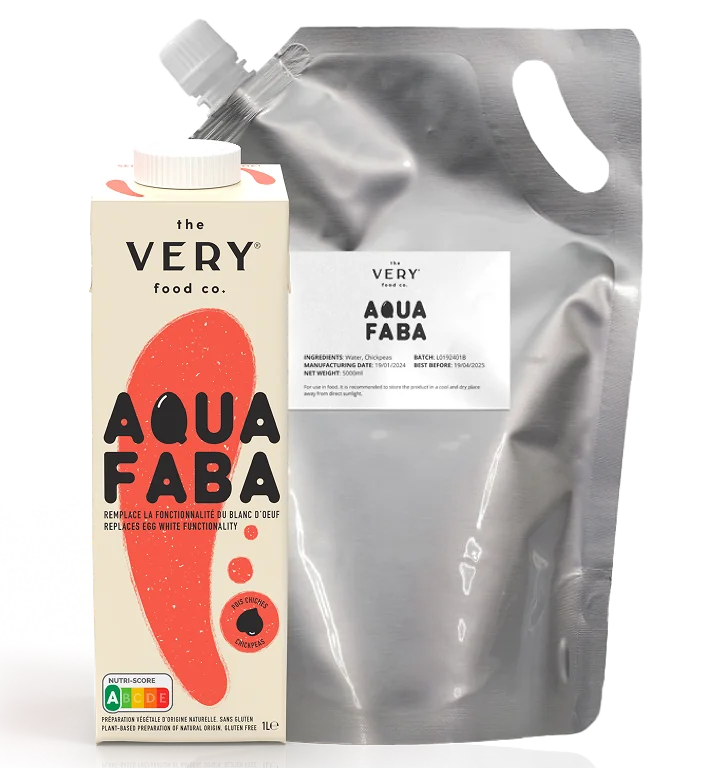
| 10L bag-in-box, liquid | 330 | Pilot runs, smaller lines and the central kitchens of a group |
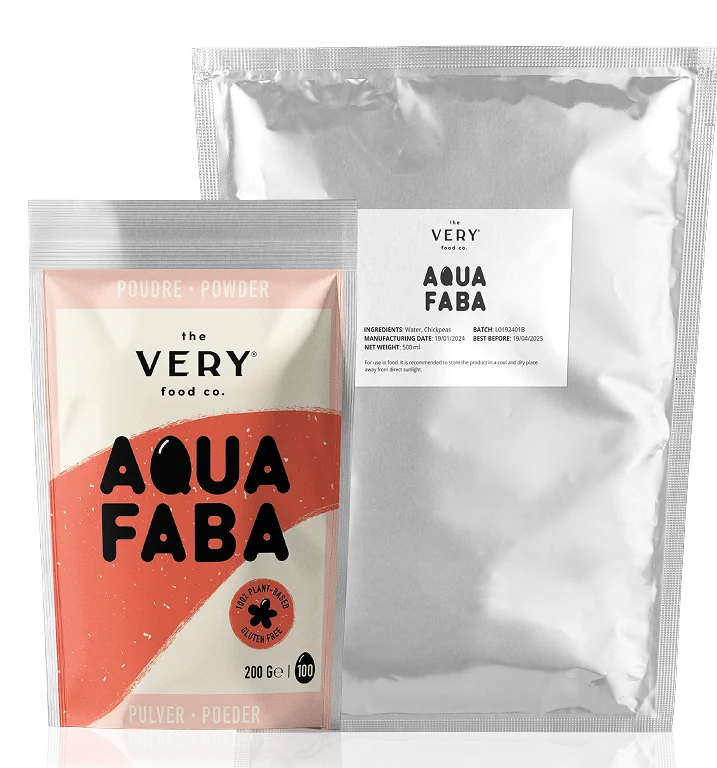
| 3kg pouch, powder | 1,500 | Dry premixes: a producer blending a dry sauce or bake base puts it into the premix as it is |
For whipped and emulsified lines the liquid is the format, because it arrives at a fixed concentration with nothing to make up. The powder earns its place in a dry premix. Once opened, the liquid is held at 2 to 6 °C and used within 3 to 4 days, which on a continuous line is simply the normal rhythm of a pack.
Getting your specification and quote
Specifications, minimum order and lead time depend on the country, the format and the volume, so they are given per project. Send us the line, the application, the formats you are considering and the estimated monthly volume through our contact form, and the technical sheet comes back with the quote. For the central kitchens of a group, where the 10L bag-in-box runs day to day, see the foodservice page.