Process sheet
How to replace eggs with aquafaba in baking: the trial sheet
Replacing the eggs in a bake is a small change that touches everything around it: the water, the bake time, the crumb. This sheet is how you keep track of what you changed and what it did: one trial per sheet, filled in as you go, and kept for the next one. Updated: .
Process sheet
| # | Step | Reference | Your batch |
|---|---|---|---|
| 1 | Note the eggs of your formula | Whole eggs, whites, yolks | |
| 2 | Work out the aquafaba | 45g per whole egg, 30g per egg white, 15g + 10g oil per yolk | |
| 3 | Decide whipped or unwhipped | Whites: whipped. Whole eggs: as it is | |
| 4 | Chill the aquafaba if it is whipped | 4 to 6 °C | |
| 5 | Whipped: fold in gently and promptly | Sponges and génoise | |
| 6 | Cakes, cookies and muffins: mix it with the sugar before the fat | A more stable emulsion | |
| 7 | Whole eggs swapped: reduce the milk or water slightly, or raise the dry ingredients | Aquafaba carries more water than egg | |
| 8 | Bake fully | The extra water lengthens the bake | |
| 9 | Note volume, crumb and moisture; re-check shelf life if you reformulated | Water activity changes |
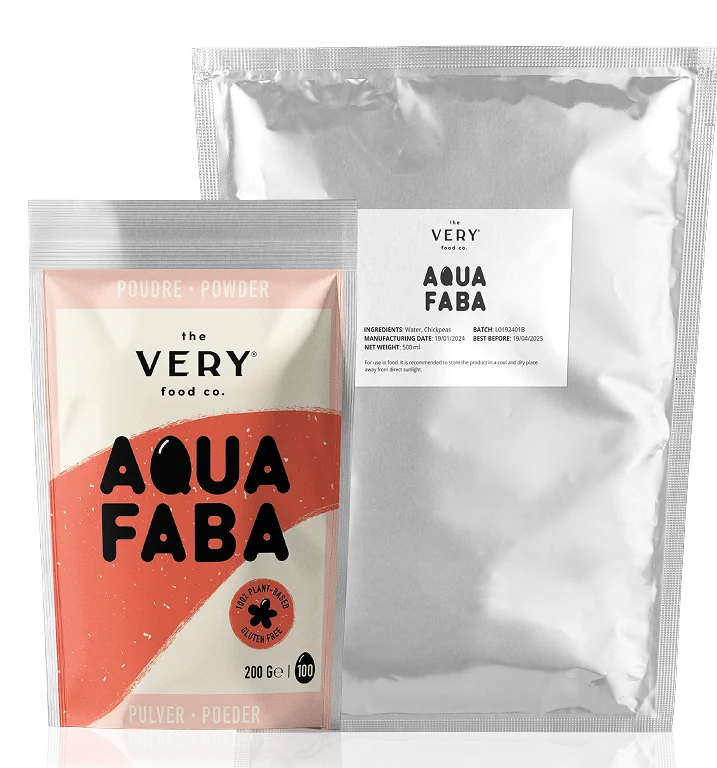
Powder: 2g + 30 ml of water per egg white, 3g + 45 ml per whole egg. For whipped bakes, chill it to 4 to 6 °C first; for doughs and batters it goes in as it is.
Checks
| What you see | Why | Fix |
|---|---|---|
| Flat sponge | The foam stood waiting, or was folded too hard | Fold in promptly and gently |
| Loose, wet batter | Whole eggs swapped one for one, water not reduced | Reduce the milk or water slightly, or add dry ingredients |
| Wet centre | The extra water lengthens the bake | Bake fully before you pull it |
| Weak foam | Aquafaba too warm | Whip it at 4 to 6 °C |
| Weak foam or binding from frozen stock | Thawed aquafaba came back thinner | Reduce briefly over low heat. Never refreeze |
| Shelf life of the product has shifted | Changing moisture changes water activity | Re-check shelf life and microbial stability after reformulating |
Source: VERY AQUAFABA, How to Use Aquafaba in Baking (September 2026)
How to use this sheet
Print one per trial, one recipe at a time, with the baking guide at hand for the method behind each step. Write your recipe's eggs at the top, then fill in the last column as you go: how much aquafaba went in and whether it was whipped, what you took out of the liquids, how long the bake ran, and what the crumb looked like when it was cool. That column is the difference between a trial you can repeat and one you have to run again.
Keep the filled-in sheets, the failed ones especially. And if a bake comes out wrong and you can't see why, send us the sheet: it is the fastest way for us to help.
Before you swap the eggs
Three things decide the trial before the oven is on:
- Which eggs you are replacing. Whites only is a direct swap. Whole eggs bring extra water. Yolks need the 10g of oil.
- Whipped or poured. Aquafaba is whipped, at 4 to 6 °C, when it stands in for whites in a sponge or a high-sugar batter. It goes in as it is when it stands in for the binding and moisture of whole eggs.
- Only the egg changes. Same flour, same mixing, same oven, or you will not know what the aquafaba did.
How to tell each step is going right
The sheet gives you the value to hit. This is how you know you have hit it:
- Step 2, the aquafaba. 45g per whole egg, 30g per egg white, weighed. In powder, 2g and 30 ml of water per egg white.
- Step 5, whipped and folded. The foam goes in as soon as it is ready, folded gently until the streaks are gone and no longer. A sponge that comes out flat stood too long or was folded too hard.
- Step 7, the water. Whole eggs swapped, so the milk or water comes down slightly, or the dry ingredients go up. The batter should look the way it did with eggs, not looser.
- Step 8, the bake. The extra water means a longer bake. A skewer comes out clean; a wet centre means it came out too soon.
- Step 9, the notes. Volume, crumb and moisture, written down while the bake is in front of you. If you changed the moisture, the shelf life of the product may have moved with it, so re-check it.
Where to buy VERY AQUAFABA
Professional enquiries: Discuss your production needs
General enquiries: Get in touch