Professionals
How to prepare and use aquafaba powder in a bakery
Before a tray of meringues or a fat-rich batter goes on the mixer, make aquafaba powder up with water. For each egg white your formula replaces, use 2g of powder with 30 ml of water, then add the made-up aquafaba, never dry powder, to the mix. That blend makes 32g of aquafaba, the same working weight as liquid aquafaba.
When you replace whole eggs, begin by reducing the recipe's other liquids by 5 to 10%. The water used to make up the powder stays as given, so it is not part of that adjustment. For batters built around whipped egg whites, chill the made-up aquafaba before whipping. For fat-rich formulas, plan where it meets sugar and fat before you start the batch. That keeps the first conversion clear when you move from formula weights to your bakery method.
Updated: .

How do you make up powder for a bake?
Set out a clean vessel of water before you scale the powder. For one egg-white replacement, 2g of powder and 30 ml of water make 32g of aquafaba. For a whole-egg replacement, use 3g of powder with 45 ml of water.
Mix the powder into the measured water before it reaches the formula, then weigh or portion that aquafaba into the batch. Do not scatter dry powder into flour, sugar, or a mixer bowl. Make up only the amount required for the bake, which keeps the recipe's water balance clear at the point of mixing.
Where does made-up powder go in the method?
Follow the role that egg played in the original formula. In a fat-rich batter, mix the made-up aquafaba with the sugar before it meets the fat. This puts the ingredient into the method without treating the powder as a dry ingredient.
A formula built on whipped egg whites needs a different step. Chill the made-up aquafaba to 4 to 6 °C, whip it, then fold it into the batter. If you are converting whole eggs, reduce other recipe liquids by 5 to 10% as a starting point. Keep the make-up water unchanged when you make that adjustment.
How do you store opened pouches?
Close the pouch as soon as you have scaled the powder and keep it dry. Opened powder that stays dry and closed keeps until the best-before date on the pouch. Read that date as the storage limit for the open pouch, rather than setting a separate day count.
Build the check into your batch preparation. Look at the best-before date before you scale the day's requirement and keep the pouch closed between uses. Unopened liquid and powder keep at least 12 months at room temperature, so an unopened pouch can stay in normal dry-store planning until you need it.
Which pouch suits your production?
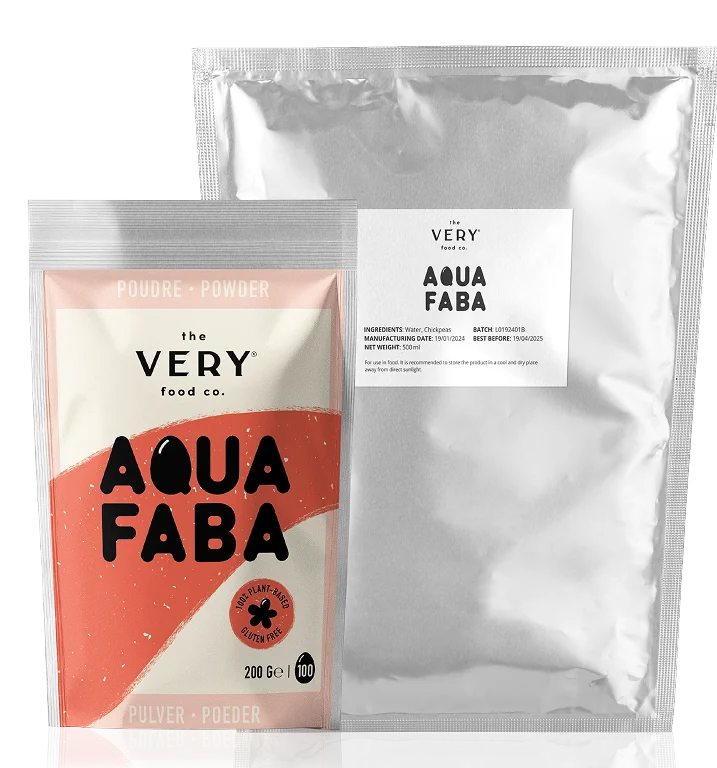
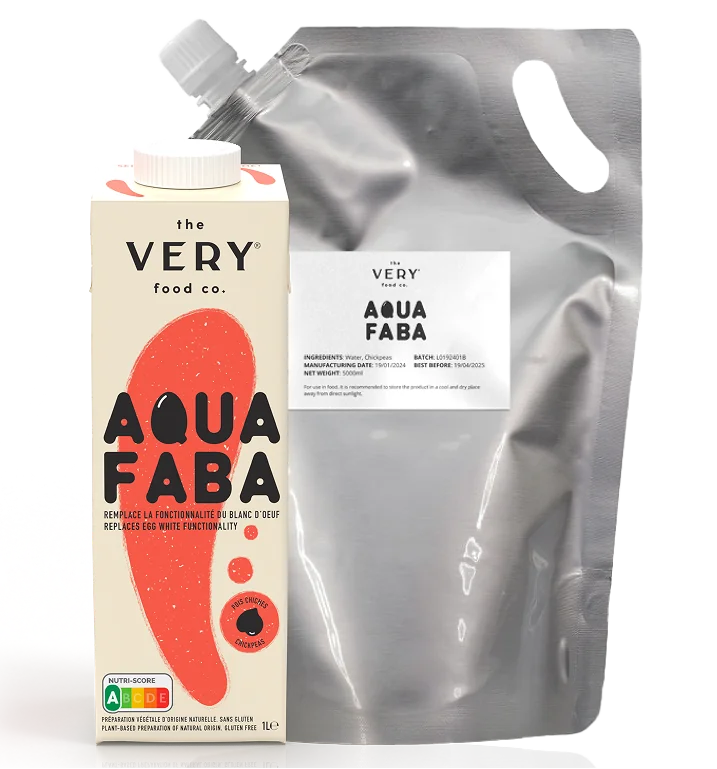
Match pouch size to the number of egg-white replacements on your production plan. A 30g pouch covers 15 egg whites, while a 200g pouch covers 100. The 3kg pouch covers 1,500 egg whites, so it calls for a production plan that accounts for its larger make-up volume.
A full 3kg pouch takes 45L of water and makes 48kg of aquafaba. That volume changes how you schedule vessels, scales, and batch size. For lower or irregular use, choose a format by the stated egg-white count. For repeated larger batches, compare that count with the quantities you plan to make up.
Put the powder and water weights on the production sheet for the next formula you convert. Make up only the amount for that batch, check the pouch best-before before prep, and select the format against your planned egg-white replacements. If you need help matching a pouch to your output, send an enquiry.
Where to buy VERY AQUAFABA