Tools
Convert egg whites to aquafaba: liquid or powder
Your meringue recipe calls for five egg whites; use 150g of liquid VERY AQUAFABA, or 10g of powder with 150 ml of water. Use 30g of liquid VERY AQUAFABA for each egg white.
When you are scaling trays of meringues or revising a production formula, start from what the recipe gives you: an egg-white count or an egg-white weight. Enter either one in the converter. It returns the liquid aquafaba weight, the powder weight, the water to add and the weight after making up the powder. A five-white recipe and a recipe written as 150g of egg white start at the same point. Use liquid when you want aquafaba ready to weigh, or make up powder only for the batch in front of you. For whole eggs and yolks, convert the egg component separately before you adjust the rest of the formula.
Updated: .
Egg white converter
Your aquafaba
Enter the egg whites in your recipe, as a number or in grams.
Start with what your recipe tells you
Read the ingredient line before you change any method. A formula that lists five egg whites and one that lists 150g of egg white both lead to the same starting conversion. Enter the count when the recipe uses eggs. Enter the weight when the recipe has already been written for a scale.
The converter returns four working figures: liquid aquafaba in grams, powder in grams, water in ml and the weight once the powder is made up. Keep the egg-white quantity separate from whole egg or yolk ingredients. Whole eggs use a different conversion, and yolks need aquafaba plus oil where their richness matters. Use the whole egg converter or recipe converter for those lines rather than folding them into your egg-white number.
See what five egg whites become
Five egg whites convert to 150g of liquid VERY AQUAFABA. With powder, make up 10g of powder with 150 ml of water first. That prepared quantity weighs 160g, so make it up, then weigh the amount your formula calls for. Do not add the powder dry to the mix.
For five egg whites in meringue:
| Ingredient | Quantity |
|---|---|
| Liquid VERY AQUAFABA | 150g |
| VERY AQUAFABA powder | 10g |
| Water for the powder | 150 ml |
| Sugar | 150g |
For the meringue method, chill the aquafaba to 4 °C, whip for 3 to 5 minutes, then bake at 90 °C for 1.5 to 2 hours. This quantity makes about 30 meringues.
Weigh your aquafaba before you start
Put the bowl on the scale and weigh the aquafaba that goes into the recipe. A formula written for 150g of egg white takes 150g of liquid VERY AQUAFABA. When you use powder for that same conversion, make up 10g of powder with 150 ml of water before you weigh the prepared aquafaba.
The powder and water figures are not interchangeable with the liquid figure. The powder route gives you 160g once made up, while the liquid route gives you 150g to add. Making the powder separately lets you prepare what the batch needs, then keep the rest of the formula unchanged unless the recipe itself calls for another adjustment.
Use the converted quantity in your recipe
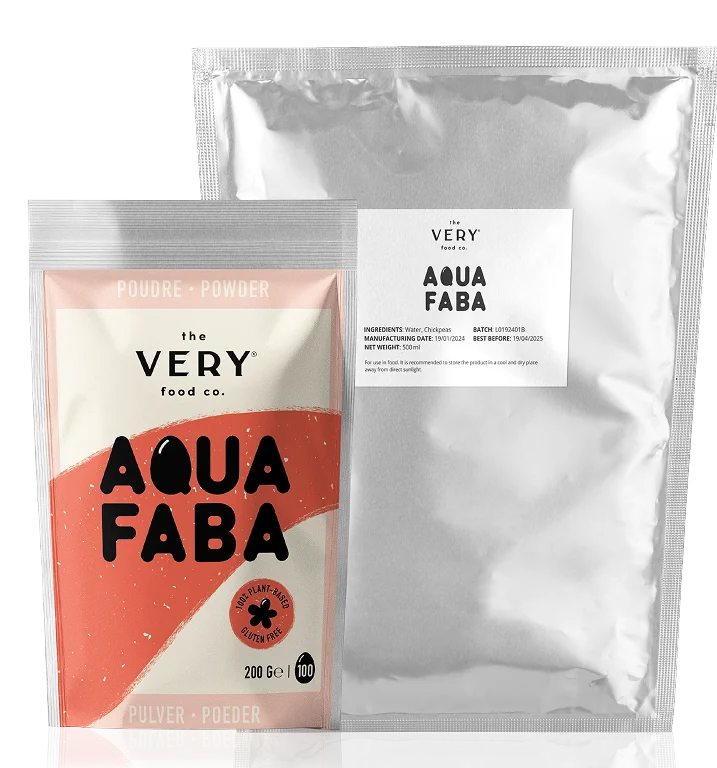
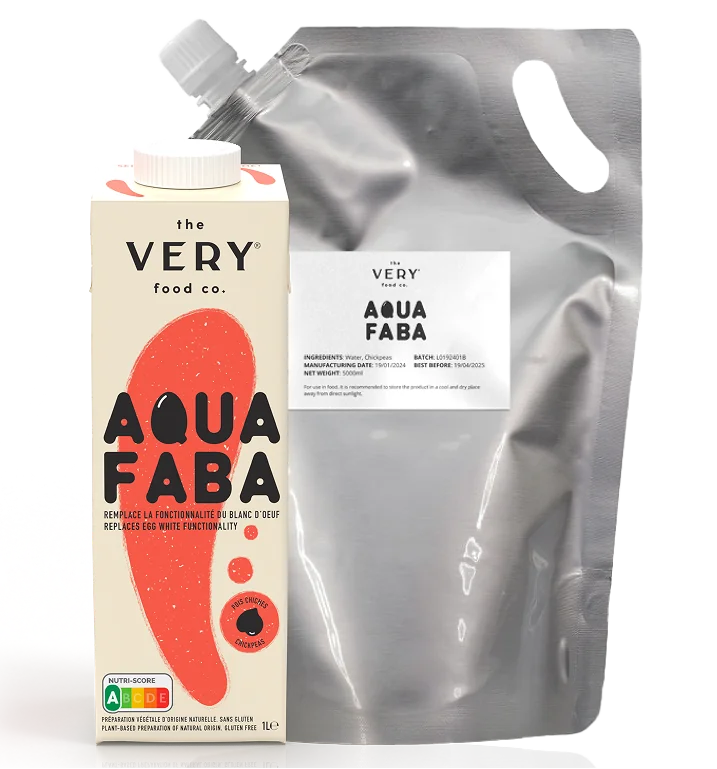
Choose liquid when you want ready-made aquafaba available to weigh across several bakes. A 1L Tetrapak replaces 33 egg whites, while a 10L bag-in-box replaces 330. For smaller or changing batches, powder lets you make up only the quantity you need. A 30g pouch replaces 15 egg whites.
Unopened liquid and powder keep for at least 12 months at room temperature. Once opened, keep liquid at 2 to 6 °C for 3 to 4 days and mark the opening date. Keep opened powder dry and closed until the best-before date on the pouch. Check the conversion before you set out the rest of your mise en place.
Enter the egg-white count or weight from your recipe, then write down the liquid or powder and water result beside your mise en place. For a meringue batch, chill the measured aquafaba before whipping. If the recipe calls for whole eggs or yolks, use the separate converter before you scale the rest of the formula.
Where to buy VERY AQUAFABA